On Page SEO Checklist for 2026: Start Ranking Higher Today
There is no doubt that SEO is evolving faster than ever. Ranking on the first page of
Google has always been challenging.
Just a decade ago, SEO was primarily about keyword stuffing, backlinks, duplicate
content, and metrics like DA and PA scores. However, many aspects of the industry have
changed. SEO is now focused on user intent, content quality, and overall user experience.
On-page SEO plays a major role in a website’s overall optimization and user experience.
With AI-driven algorithms and smarter search behavior, businesses must adapt to stay
visible online. Search engines now prioritize intent, structure, and usability, making on-
page optimization more important than ever.
In this guide, you’ll get a complete and actionable On-page SEO checklist for 2026 to
help you optimize your pages and start ranking higher today.
On Page SEO 2026: A Quick Overview
On Page SEO is something when it comes to improving the website structure such as
optimizing title tag, meta description, website speed, website pages structures etc.
It also includes the following:
- Content optimization
- HTML elements (title tags, meta descriptions, headings)
- URL structure
- Internal linking
Some Other Elements in On Page SEO
- Header Tags: Using headers to organize content so that visitors can read it and search
engines can skim it.
Examples: H1, H2, H3, H4, H5, H6 - User Experience (UX): Here user experience means how well a user is interacting with
your website.
Examples: Suppose a user is experiencing glitches in filling form which means having bad user experience and if the website CTA’s are working smoothly then it’s good user experience. - Image SEO: Image SEO is something that when a user performs a particular search on Google then relevant image comes because of having a alt attribute.
- Structured Data: Here, structure data means representation of your website in Google search engine or how crawlers understand your website through structured data.
Top Key Trends in On Page SEO 2026
To succeed in 2026, you need to align with modern SEO trends:
- AI & semantic search: Search engines understand context, not just keywords
- Search intent focus: Content must directly answer user queries
- EEAT principles: Experience, Expertise, Authority, and Trust matter
- UX signals: Engagement metrics influence rankings
On Page SEO Checklist 2026: Priority Basis Factors
Here, we’ve arranged all the on page SEO factors priority wise.
1. Title & Meta Description Optimization
Well, Title & Meta descriptions are the primary elements of a website and which displays
in search engines whenever any search is performed.
In SEO, Title tag length must be lie between 50-65 characters and Meta description
length must be 150 to 160 characters.
Example: There a number of types in titles such as simple titles, CTA based, news article
titles
2. Structured Data (Schema Markup)
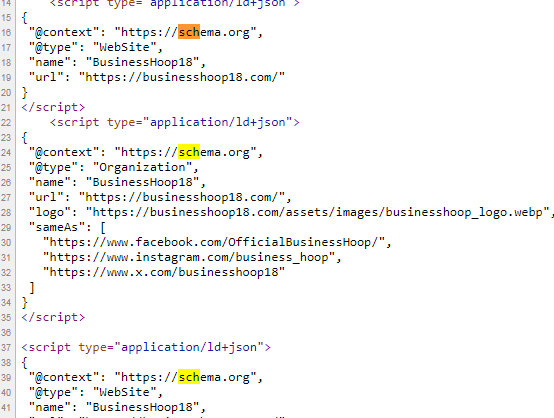
Structured Data which is also known as the schema markup code (consists of piece of
code in JSON-LD)
This code is basically inserted in the head section of a webpage and tells the proper
structure of a website to crawlers.
As you can see in the above image, this is the example of structured data code
Popular Schema Types to Know
Article Schema: Whenever any article is published on a blog, Google’s crawler tries to
understand the structure of the content.
This kind of schema is specifically optimized news, general articles, blogs for rich results
and Google news.
Local Business Schema: This schema is basically used for local businesses such as shops, store and any business within city.
Product Schema: Product schema plays an essential role in enhancing e commerce websites or any other product based site. Whenever we make a Google search then product reviews shows as start rating in Meta description.
HowTo Schema: As its name suggests, A HowTo schema is implemented when you have how to articles published in your blog section.
3. URL Structure
Well, this is the third most important part in on-page SEO. A URL structure enhances the
crawlability, user experience, and descriptive navigation and helps search engine
understands the content.
Simple and clean URLs are easy to understand and even looks more credible and
authoritative.
Example: www.abc.com/seo-company-in-ludhiana=?Wskjdiioq1kkplp
Correct: www.abc.com/seo-company-ludhiana
4. Header Tags (H1, H2, H3...H6)
Just imagine a car without a headlight. Seems scary? Header tags are the HTML tags that
are regarded as the main breakers of the content and helps understand the content through
multiple headings
Example: H1, H2, H3, H4….H6
In the content of any website, there is a need of proper heading placement
5. Page Speed
Suppose you’ve to book movie tickets online from an XYZ website and suddenly the
page starts loading due to the page speed issues.
Around 70% to 80% of the users would divert to other website for better user experience
and fast booking. Whenever it’s a discussion of website speed there comes the major
metrics.
LCP (Largest Contentful Paint )
FCP ( First Contentful Paint )
INP ( Interaction to Next Paint )
6. Mobile Responsiveness (Mobile First-Indexing)
In the article of SEO checklist 2026 responsive layouts of the website is must because
around 80%-90% of the users access websites on mobile devices.
It’s a core ranking factor because search engines use mobile-first indexing, meaning they
primarily evaluate the mobile version of your website for ranking and indexing.
A mobile-responsive website automatically adapts its layout, content, and design to fit
different screen sizes (smartphones, tablets, etc.) without breaking usability.
Conclusion
So far, we’ve discussed the on page SEO checklist 2026, where we’ve learned the top on
page SEO factors.
By using this on-page SEO checklist, you're creating content that engages readers, builds
trust, and promotes long-term rankings rather than just optimizing for algorithms. Every
element affects your total success, from creating intent-driven content and refining
technical components to boosting mobile usability and site performance.
What is Email marketing?
Think of it as a gentle nudge, not a pushy salesman. Email marketing is like a trusted voice in the digital world, subtly reminding you about your favorite brands, offering helpful tips, and making sure you don't miss out on exclusive deals...
Read MoreWhat is Search Engine Optimization (SEO)?
Envision a hidden stairway leading to the top of a towering online skyscraper. SEO builds that stairway, step by step, boosting your website's ranking...
Read MoreWhat is Digital Marketing ?
In today's connected world, digital marketing has emerged as an crucial tool for businesses of all types to extend a large-scale of audience, promote...
Read MoreTop Trends in Digital Marketing
Many new digital marketing trends and strategies are evolving in the current high-tech, Internet-connected era which means that businesses need to use...
Read MorePainting Competition
We arranged a Painting Contest for our employees and announced that everyone will be a part of this and they will be divided into different teams...
Read More